
Quick Summary
Introduction
The SBI Clerk Notification 2026 has been released for over 9000 Junior Associate posts, and lakhs of graduates are preparing to apply. But before you fill the application form, there is one thing you must check first: SBI Clerk eligibility 2026. Many candidates who clear the exam still get rejected at the document verification stage because they missed a small eligibility detail. The local language rule, the age calculation date, the final year graduation deadline, the backlog vacancy category, these are the traps that catch unaware aspirants.
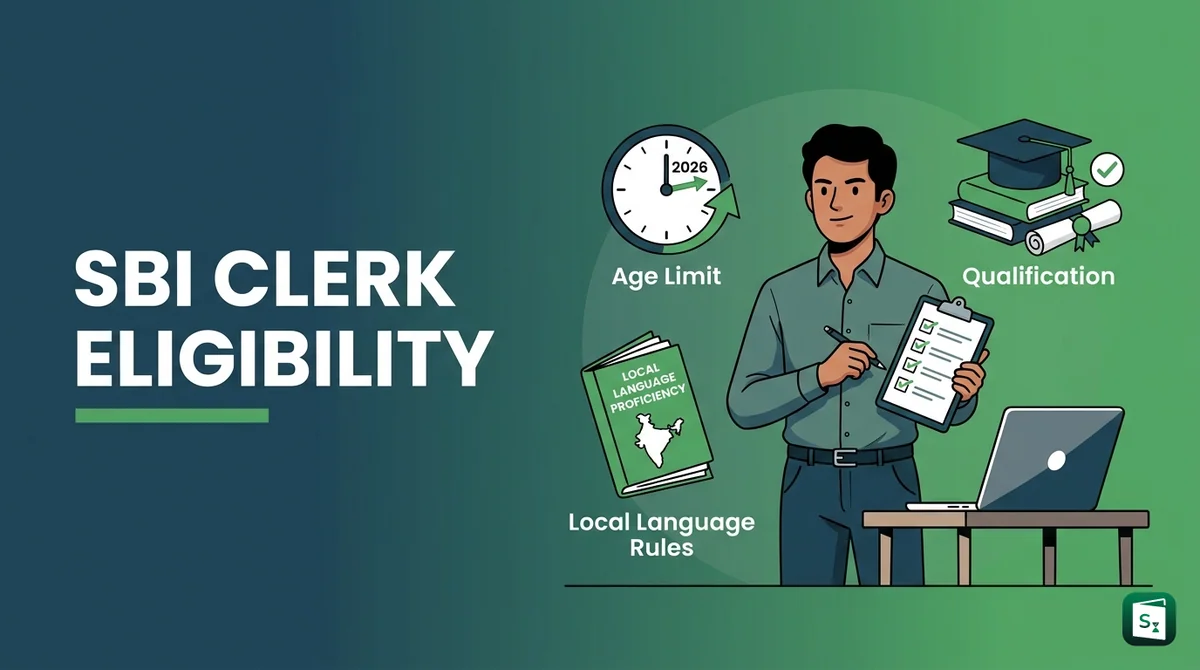
This article explains every eligibility condition for SBI Clerk 2026 in plain language. We have covered age limits with category-wise relaxations, educational qualifications, the local language proficiency rule and how it is verified, who is not eligible to apply, and the difference between regular and backlog vacancies. If you read this carefully before applying, you will not face any surprises later.
SBI Clerk 2026 Eligibility: Quick Overview
Before we go into the details, here is a snapshot of all the key eligibility conditions for SBI Clerk 2026:
| Criteria | Requirement |
|---|---|
| Post | Junior Associate (Customer Support and Sales) |
| Minimum Age | 20 years |
| Maximum Age | 28 years (General category) |
| Educational Qualification | Graduation in any discipline from a recognised university |
| Minimum Percentage | No minimum required |
| Nationality | Indian citizen (certain other categories also eligible) |
| Local Language | Must read, write, speak, and understand the local language of the applied state |
| Number of Attempts | No limit |
| Application Fee | ₹750 (General/OBC/EWS), Nil (SC/ST/PwBD/XS/DXS) |
| Selection Process | Prelims, Mains, Local Language Proficiency Test |
The SBI Clerk 2026 recruitment has two separate drives this year. The regular recruitment carries 7680 vacancies and the Special Recruitment Drive for SC/ST/OBC backlog vacancies carries 1538 additional posts. You can apply for only one state or union territory. The last date to apply for the regular recruitment is 31 August 2026.
Age Limit and Category-wise Relaxations
The age limit for SBI Clerk 2026 is strict and non-negotiable. Candidates must be between 20 and 28 years of age as on 01.04.2026. This means your age is calculated on 1 April 2026, not on the date you apply or the date of the exam.
Age Calculation Made Simple
SBI calculates your age based on a specific cutoff date. For SBI Clerk 2026, the cutoff date is 01 April 2026. To be eligible, you must have been born not earlier than 02.04.1998 and not later than 01.04.2006 (both dates inclusive).
Here is how to calculate your age:
- If your date of birth is 2 April 1998, you will be 27 years 11 months and 29 days old on 1 April 2026. You are eligible.
- If your date of birth is 1 April 2006, you will be exactly 20 years old on 1 April 2026. You are eligible.
- If your date of birth is 31 March 1998, you will be 28 years and 1 day old on 1 April 2026. You are not eligible.
Tip: Many candidates make the mistake of calculating their age on the date of application or the exam date. Always use the cutoff date mentioned in the notification. Even one day over the limit makes you ineligible.
Age Relaxation Table
Age relaxation applies only to the upper age limit. The minimum age remains 20 years for all categories. The relaxation is available for the following categories as per Government of India rules:
| Category | Age Relaxation | Maximum Age |
|---|---|---|
| General / EWS | Nil | 28 years |
| OBC (Non-Creamy Layer) | 3 years | 31 years |
| SC / ST | 5 years | 33 years |
| PwBD (General / EWS) | 10 years | 38 years |
| PwBD (OBC) | 13 years | 41 years |
| PwBD (SC / ST) | 15 years | 43 years |
| Ex-Servicemen / Disabled Ex-Servicemen | Actual period of service in defence + 3 years (8 years for SC/ST Disabled Ex-Servicemen) | Maximum 50 years |
| Widows, Divorced women, women judicially separated (not remarried) | 7 years | 35 years (General/EWS), 38 years (OBC), 40 years (SC/ST) |
| Trained Apprentices of SBI | General/EWS: 1 year, OBC: 4 years, SC/ST: 6 years, PwBD (General/EWS): 11 years, PwBD (OBC): 14 years, PwBD (SC/ST): 16 years | As applicable |
Important points to remember:
- Cumulative age relaxation is not allowed. You cannot combine relaxation under two different categories.
- No change in category is permitted after you submit the online application.
- Candidates seeking age relaxation must produce the necessary certificates at the time of document verification.
Educational Qualification
To apply for SBI Clerk 2026, you must have a graduation degree in any discipline from a recognised university or any equivalent qualification recognised by the Central Government. The qualifying date for educational qualification is 31.12.2026.
This means all streams are accepted: Arts, Science, Commerce, Engineering, Management, Computer Applications, and all others. There is no minimum percentage requirement in graduation. Even if you have scored 50% or 55%, you are eligible as long as you have passed.
Can Final Year Students Apply?
Yes. If you are in your final year or final semester of graduation, you can apply provisionally. But there is a condition: if you are selected, you must produce proof of having passed the graduation examination on or before 31 December 2026.
This proof must show the date of passing as appearing on your mark sheet or certificate. If your result is posted on the university website, a certificate from the appropriate authority indicating the date of posting will be accepted.
Warning: If you cannot produce proof of graduation by 31.12.2026, your candidature will be cancelled even if you have cleared the Prelims and Mains. Make sure your result is declared before this deadline.
What About IDD and Distance Education?
Candidates holding an Integrated Dual Degree (IDD) certificate must ensure that the date of passing the IDD is on or before 31.12.2026. The same deadline applies.
For distance education degrees, the qualification is accepted provided the university is recognised by the Central Government or the University Grants Commission (UGC). However, always verify this against the official notification before applying.
Local Language Proficiency: The Most Confusing Rule
The local language requirement is what makes SBI Clerk eligibility different from most other banking exams. When you apply, you choose a specific State or Union Territory. Along with that state, you also choose a local language. You must be able to read, write, speak, and understand that language. This is not optional. It is a mandatory eligibility condition.
What Does Local Language Proficiency Mean?
When SBI says you must be proficient in the local language, they mean you need practical ability in four areas:
- Reading: You must be able to read passages, notices, and documents in that language
- Writing: You must be able to write short paragraphs or answers in that language
- Speaking: You must be able to communicate with customers in that language
- Understanding: You must be able to comprehend what others say in that language
The proficiency required is functional, not literary. SBI expects you to handle day-to-day customer interactions in the regional language of the state where you will be posted.
How Is It Verified?
SBI verifies your local language proficiency through the Local Language Proficiency Test (LLPT), which is conducted after you clear the Mains Examination but before you receive the appointment letter.
The LLPT is a written test that includes:
- Reading comprehension based on a passage in the local language
- Answering questions related to the passage
- Translation of a paragraph into the local language
- Fill in the blanks and basic grammar questions
If you fail the LLPT, you will be disqualified from the entire recruitment process. There is no second chance.
Who Gets Exempted?
You are exempted from the LLPT if you can produce a valid Class 10 or Class 12 mark sheet or certificate showing that you studied the specified local language as a subject.
For example, if you are applying for Maharashtra and you studied Marathi as a subject in Class 10 or 12, you do not need to appear for the LLPT. You just need to submit your mark sheet as proof during document verification.
Key points about exemption:
- The mark sheet or certificate must clearly show the local language as a subject you studied
- The language must match the language required for the state you are applying to
- Once the application is submitted, you cannot change the state or the language choice
Can English Medium Students Apply in Hindi States?
This is one of the most commonly asked questions. The answer is: yes, you can apply, but you must be proficient in Hindi (or the specified local language of that state).
Studying in an English medium school does not automatically make you ineligible for states like Uttar Pradesh, Madhya Pradesh, Rajasthan, or Delhi, where Hindi is the local language. However, you must be able to read, write, and speak Hindi well enough to clear the LLPT.
If you studied Hindi as a subject in Class 10 or 12, you are exempt from the LLPT. If you did not, you will need to appear for the test and pass it.
Practical advice: If you cannot comfortably write a paragraph in Hindi without help, think carefully before applying for a Hindi-speaking state. Choose a state where you are genuinely proficient in the local language. The language requirement is not a formality. It determines whether you get the appointment or not.
Important: Once you select a state and submit the application, you cannot change your choice. The posting will also be in the same state. There is no provision for inter-state or inter-circle transfers for Junior Associates before completing 5 years of service.
Who Is Not Eligible for SBI Clerk 2026?
Even if you meet the age, qualification, and language requirements, certain candidates are specifically barred from applying. These are disqualification conditions that SBI enforces strictly.
Candidates who are NOT eligible:
- Current SBI employees in clerical cadre: If you are currently working as a Junior Associate or Clerk in SBI, you cannot apply for this recruitment.
- Former SBI clerical employees who resigned: If you previously worked in SBI’s clerical cadre and resigned from the bank, you are not eligible to apply again.
- Candidates with adverse character reports: If there is an adverse report regarding your character, antecedents, or moral turpitude, you are not eligible.
- Candidates with poor CIBIL status: If you have a poor credit history or adverse reports from banks or financial institutions, you may be disqualified.
- Candidates who cannot produce valid category certificates: If you claim relaxation under OBC, SC, ST, or EWS but cannot produce the required certificate at the time of document verification, your candidature will be cancelled.
Nationality requirement:
You must be one of the following:
- A citizen of India
- A subject of Nepal
- A subject of Bhutan
- A Tibetan refugee who came to India before 1 January 1962 with the intention of permanently settling in India
- A Person of Indian Origin (PIO) who has migrated from specified countries with the intention of permanently settling in India
Candidates belonging to categories other than Indian citizens must possess a valid certificate of eligibility issued by the Government of India.
Note: There is no limit on the number of attempts. You can apply as many times as you want, as long as you meet the age limit and other eligibility conditions.
Backlog Vacancies vs Regular Vacancies: What Is the Difference?
The SBI Clerk 2026 notification has announced two types of vacancies. Understanding the difference between them is important, especially if you belong to a reserved category.
Regular Vacancies
These are the standard openings created by SBI based on retirement, expansion, or operational requirements. There are 7680 regular vacancies in the 2026 cycle. All eligible candidates, regardless of category, can apply against these posts.
Backlog Vacancies
Backlog vacancies are unfilled positions from previous recruitment cycles that were reserved for SC, ST, and OBC candidates but could not be filled due to non-availability of eligible candidates. SBI conducts a Special Recruitment Drive to fill these positions.
In 2026, there are 1538 backlog vacancies:
| Category | Backlog Vacancies |
|---|---|
| SC | 207 |
| ST | 1219 |
| OBC | 112 |
| Total | 1538 |
Key differences:
- Backlog vacancies are only for SC, ST, and OBC candidates. General and EWS candidates cannot apply against backlog posts.
- The backlog recruitment has a separate notification (Advertisement No. CRPD/CR/SPLDRIVE/2026-27/16) and a separate application window (7 August to 27 August 2026).
- The eligibility criteria for backlog vacancies are the same as regular vacancies, except that only SC, ST, and OBC candidates are eligible.
- The selection process, exam pattern, and salary are the same for both regular and backlog recruitment.
Tip: If you belong to SC, ST, or OBC category, you can apply for both regular and backlog vacancies. This gives you two opportunities to get selected. However, you can apply for only one state in each recruitment drive.
Application Fee and State Selection Rules
Application Fee
The application fee for SBI Clerk 2026 is non-refundable. Once paid, it cannot be refunded or held in reserve for any other exam.
| Category | Application Fee |
|---|---|
| General / OBC / EWS | ₹750 |
| SC / ST / PwBD / XS / DXS | Nil |
The fee must be paid online through debit card, credit card, or internet banking. No other mode of payment is accepted.
State Selection Rules
When you apply, you must choose one State or Union Territory. The rules are:
- You can apply for only one state. Applying for multiple states will lead to rejection of all applications.
- The state you choose determines where you will be posted. There is no provision for inter-state transfer before completing 5 years of service.
- The local language you claim must match the language required for the state you select.
- Once the application is submitted, you cannot change your state or language preference.
Practical strategy for state selection:
Choose a state where you are genuinely proficient in the local language. Do not pick a state just because it has more vacancies. The local language test is a real barrier, and failing it means losing the job even after clearing the written exams.
Also check the state-wise vacancy table in the official notification before choosing. Some states have far more vacancies than others, which can affect your chances. For example, Maharashtra has 1718 regular vacancies while Himachal Pradesh has only 9.
Official and Helpful Links
What to do next?
Now that you know the complete eligibility criteria, here is what you should do next:
-
Verify your age: Calculate your exact age as on 01.04.2026. Make sure you fall within the eligible range for your category. If you are even one day over the limit, do not apply.
-
Check your graduation status: If you are in your final year, confirm that your result will be declared before 31 December 2026. Keep your mark sheets and degree certificates ready.
-
Confirm your local language: Check your Class 10 and 12 mark sheets. If you studied the local language of your chosen state, keep those certificates ready. If you did not, start preparing for the LLPT now.
-
Choose your state carefully: Pick a state where you are genuinely strong in the local language. Do not gamble on this.
-
Apply before the deadline: The last date to apply is 31 August 2026. Do not wait until the last day. Server loads increase near the deadline.
-
Start your preparation: The Prelims is tentatively scheduled for September 2026 and the Mains for November 2026. Smart aspirants know that while everyone focuses heavily on Quant and Reasoning, the real selection happens in Current Affairs and English. These are the subjects that separate selected candidates from the rest.
Use the Scoreclever Current Affairs Website for detailed daily current affairs coverage, and download the crisp daily Banking PDFs from Scoreclever’s Telegram channel. For vocabulary and English preparation, try the Scoreclever App, which schedules revisions automatically so you do not forget what you learn. Participate in the daily Current Affairs League at 8 PM and Vocab League at 7 PM on Telegram to test yourself against thousands of other aspirants.