

Quick Summary
Introduction
Confused between bank of baroda wealth vs credit analyst roles in 2026? You are not alone. Bank of Baroda has announced 1,100 regular Specialist Officer posts together, with 1,000 posts for Bank of Baroda wealth manager level Wealth Executives and 100 posts for Bank of Baroda credit manager level Credit Analysts in Corporate and Institutional Credit.
Both are government bank officer jobs. Bank of Baroda is a public sector bank owned by the Government of India, not a private bank. But the daily work, pay, eligibility, targets and career path of these two roles are very different.
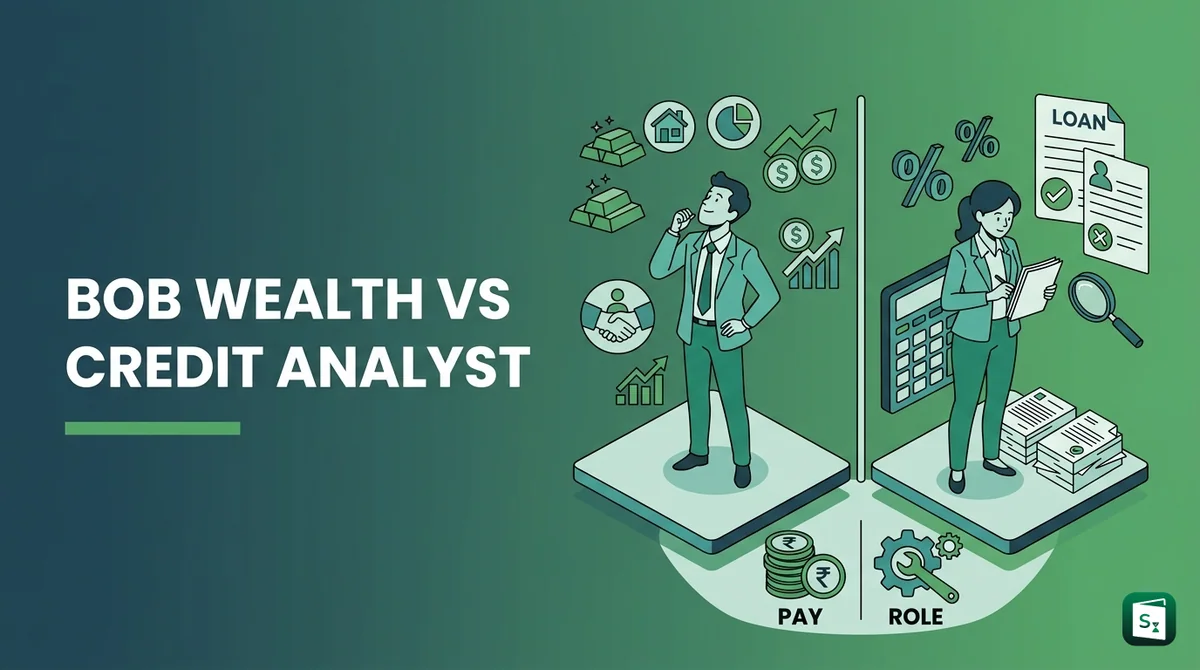
One role is sales and relationship based. The other is analysis and balance sheet based. This guide compares Bank of Baroda wealth management salary with Bank of Baroda credit analyst salary, plus duties, eligibility, posting, transfers and growth, so commerce graduates and bankers can pick based on strength.
Roles At A Glance 2026
Both posts come from the same advertisement, BOB/HRM/REC/ADVT/2026/17, dated 4 September 2026. Both are regular jobs, not contract jobs. Applications are online only from 4 September to 24 September 2026. Eligibility is counted as on 1 September 2026.
Here is a quick comparison.
| Point | Wealth Executive | Credit Analyst (C and IC) |
|---|---|---|
| Department | Wealth Management Services | Corporate and Institutional Credit |
| Vacancies | 1,000 | 100 |
| Officer scale | JMG/S-I (Junior Management Grade Scale 1) | MMG/S-II (Middle Management Grade Scale 2) |
| Age limit | 22 to 32 years | 21 to 33 years |
| Basic qualification | Graduation in any subject | Graduation in any subject plus Chartered Accountant (CA) |
| Extra must have | One valid certificate from IC 38, NISM V-A, NISM XXI-A or NISM V-D | Minimum 1 year banking experience in a Scheduled Commercial Bank |
| Core work | Client acquisition and wealth sales | Balance sheet appraisal and credit monitoring |
| Main posting | Branches and clusters with affluent customers | Central offices and corporate credit hubs |
| Service bond | 3 years, up to ₹2 lakh if you leave early | 3 years, up to ₹3 lakh if you leave early |
Note: Scale means officer rank and pay level. JMG/S-I is the entry officer rank. MMG/S-II is one level higher, with higher basic pay and more responsibility.
Wealth Executive Work
The Wealth Executive is a Bank of Baroda wealth manager at officer level. Your job is to grow wealth business from affluent, HNI and UHNI customers. HNI means High Net Worth Individual. UHNI means Ultra High Net Worth Individual. These are customers with high deposits and investment capacity.
Daily work includes five parts.
- Business development: Find new customers, onboard New to Bank and New to Wealth customers, and get referrals from existing customers.
- Wealth penetration: Deepen each customer relationship. Increase Total Relationship Value (TRV) and Assets Under Management (AUM). TRV means total business a customer gives to the bank. AUM means total investments you manage.
- Product sales: Sell mutual funds and SIPs, life and health insurance, portfolio services and other investment products.
- Digital adoption: Push customers to use digital wealth platforms for investments and insurance.
- Compliance: Keep KYC and suitability records correct, follow RBI rules, and keep your certificates valid.
Eligibility for wealth role
- Graduation in any subject from a recognised university.
- One valid certificate as on 1 September 2026 from this list: IC 38 from Insurance Institute of India, NISM Series V-A for Mutual Fund Distributors, NISM Series XXI-A for Portfolio Services Distributors, or NISM Series V-D for Specialised Investment Fund Distributors. NISM means National Institute of Securities Markets. These certificates prove you can legally sell investment and insurance products.
- Minimum 2 years experience in sales of wealth products with public sector banks, private banks, foreign banks, broking firms, asset management companies or wealth companies in India.
- Preferred only: 2 year full time MBA or PG Diploma in Finance, Marketing or Banking. This is not compulsory.
Clerical experience is not counted. Experience of less than six months in any firm is not counted, unless it is your current job.
Credit Analyst Work
The Credit Analyst in C and IC is a Bank of Baroda credit manager for large corporate accounts. C and IC means Corporate and Institutional Credit. Your job is to check if a company can repay a big loan, and then monitor that loan.
Daily work includes:
- Credit appraisal: Study financial statements, cash flow, business model and risks of existing and new corporate customers.
- Support to Relationship Managers: Help RMs get new corporate clients and cross sell other products like current accounts and trade services.
- Account maintenance: Track limits, renewals, documents and compliances in corporate accounts.
- Audit and inspection: Handle internal audit, RBI inspection and compliance queries. Keep files clean.
This is desk plus client work. You visit companies, meet finance teams, and write appraisal notes. Accuracy matters more than sales talk. One weak appraisal can create a bad loan for the bank.
Eligibility for credit role
- Graduation in any subject plus Chartered Accountant (CA) qualification. CA means a professional course in accounting, audit and tax conducted by ICAI.
- Minimum 1 year banking experience in a Scheduled Commercial Bank as on 1 September 2026. A Scheduled Commercial Bank means a bank listed in the RBI schedule, which includes most public and private banks in India.
- Preferred: experience in corporate credit. Candidates with corporate credit exposure get preference, but it is not compulsory.
This role suits commerce graduates who completed CA and already work in a bank. Freshers without CA and without banking experience cannot apply.
Bank of Baroda Wealth vs Credit Analyst Pay
Many aspirants search the pay difference first. Here is the clear picture for Bank of Baroda wealth management salary versus Bank of Baroda credit analyst salary.
Both follow the officer pay scales used in public sector banks. The figures below are basic pay scales from the notification. They are not fixed in hand salary. Final salary adds allowances like DA, HRA and special allowance, and deducts PF, tax and other items.
| Point | Wealth Executive JMG/S-I | Credit Analyst MMG/S-II |
|---|---|---|
| Starting basic pay | ₹48,480 | ₹64,820 |
| Full basic scale | ₹48,480 to ₹85,920 | ₹64,820 to ₹93,960 |
| Typical monthly in hand at start | Around ₹65,000 to ₹75,000 depending on city | Around ₹80,000 to ₹90,000 depending on city |
| Allowances | DA, HRA, CCA, special allowance, medical and retirement benefits as per bank rules | DA, HRA, CCA, special allowance, medical and retirement benefits as per bank rules |
| Incentive style | Higher chance of sales linked incentives for mutual fund, SIP and insurance business | Mostly fixed officer pay, with limited performance linked payout |
Credit Analyst starts about ₹16,000 higher in basic pay. That is because it is MMG/S-II, one scale above JMG/S-I.
But Wealth Executives can close the gap through business incentives. If you regularly meet AUM, SIP mobilisation and insurance targets, total yearly earnings can grow fast. If you miss targets, pressure grows and incentives fall. Credit Analyst pay is more stable and less linked to monthly sales.
Pro Tip: Do not compare only starting salary. Compare fixed pay versus incentive heavy pay. If you like sales, wealth can pay more over time. If you want stable pay, credit is safer.
Work And Posting Compared
Sales vs analysis
Wealth is client acquisition versus balance sheet appraisal in credit. Wealth success is measured by new customers, TRV growth, AUM growth, SIP count and insurance premium. Credit success is measured by quality of appraisal, timely renewals, clean audits and low bad loans.
- Wealth needs strong talking, networking and follow up skills.
- Credit needs strong accounting, ratio analysis and report writing skills.
NISM vs CA and CFA path
Wealth needs NISM or IC 38 certificates and sales experience. These are short term certifications focused on mutual funds, portfolio services and insurance. You must keep them valid during the job.
Credit needs CA. CA is a long professional course. Many credit officers later add CFA or risk certifications for growth. CFA means Chartered Financial Analyst, a global course in investment and finance. For promotion in corporate credit, knowledge of balance sheets matters more than sales certificates.
Branch vs central office posting
Both posts carry All India posting liability. You must be ready to serve anywhere in India.
In practice:
- Wealth Executives sit in branches and clusters where affluent customers live, mostly in metros and large cities. Transfers depend on business needs and portfolio performance.
- Credit Analysts sit in corporate credit hubs, zonal offices and central processing centres. Transfers are fewer but moves to Mumbai and other corporate centres are common.
Wealth has more daily travel for customer meets. Credit has more file work, committee meetings and audit queries.
Which Role Suits You?
Pick based on your strength, not just vacancies. Wealth has 1,000 posts, but needs sales aptitude. Credit has only 100 posts, but needs CA with banking experience.
Choose Wealth Executive if:
- You have 2 years experience in selling wealth, mutual fund or insurance products.
- You already hold valid IC 38 or NISM V-A, XXI-A or V-D certificates.
- You enjoy meeting people, handling HNI customers and closing targets.
- You have an MBA in Finance, Marketing or Banking and want a sales led private banking career.
Choose Credit Analyst if:
- You are a CA with at least 1 year experience in a Scheduled Commercial Bank.
- You enjoy reading balance sheets, cash flows and project reports.
- You want fixed officer pay, audit exposure and a corporate credit ladder.
- You aim for long term roles like Senior Manager Credit, Chief Manager and risk head.
Commerce graduates without CA should note this clearly. Graduation alone is not enough for either post. Wealth needs NISM or IC 38 plus 2 years sales experience. Credit needs CA plus 1 year banking experience. Plan your certificate first, then apply.
Bank of Baroda is often compared with SBI, PNB and Canara Bank. All are public sector banks with similar officer scales. The main difference is role design. BOB has built a large separate wealth vertical with 1,000 field roles, while corporate credit roles are fewer and more centralised. If you want customer facing growth, wealth gives faster entry. If you want technical depth, credit gives stronger long term value.
Transfers And Growth Path
Long term private banking careers
Wealth can lead to Senior Relationship Manager, Territory Head, Group Head and private banking head roles. Top performers move to premium banking, investment advisory and team lead posts. Skills in AUM growth, portfolio review and insurance planning stay useful even outside PSU banks.
Corporate credit ladders
Credit can lead to Senior Manager Credit, Chief Manager, Assistant General Manager in credit and risk teams. You gain compliance and audit exposure, which helps for risk management, large corporate appraisal and policy roles. This path values accuracy, documentation and knowledge of RBI guidelines.
Transfers and pressure
- Wealth transfers often link to business potential of a city or cluster. High business centres get more wealth staff.
- Credit transfers often link to corporate hubs and processing centres.
- Wealth pressure is monthly and target based. Credit pressure peaks during renewals, audits and large proposals.
Selection and bond
Selection may include scrutiny of applications, online test, psychometric test, group discussion and interview. The bank will confirm if an online test is held. Final merit depends on overall performance and document checks.
Both posts need a 3 year service commitment. If you leave early, you pay three months gross salary, up to ₹2 lakh for Wealth Executive and up to ₹3 lakh for Credit Analyst.
Warning: Apply for only one post. If you send multiple applications, only the latest valid application is kept. Extra fees paid for other applications are not refunded.
Common Doubts Answered
Is Bank of Baroda private or government?
Bank of Baroda is a government bank. It is a public sector bank with majority holding by the Government of India, around 64 percent. It was nationalised in 1969. It is listed on BSE and NSE, but control stays with the government.
What is LBO job in bank?
LBO usually means Local Bank Officer. It is a generalist officer job handling branch banking, loans, deposits and customer service in a local area. It is different from both roles here. Wealth Executive handles investment sales. Credit Analyst handles corporate loan appraisal. LBO handles overall branch work.
Can freshers apply for Bank of Baroda recruitment 2026 for freshers?
No, not for these two posts. Wealth needs 2 years wealth sales experience plus NISM or IC 38. Credit needs CA plus 1 year banking experience. Fresh commerce graduates should first get the certificate and relevant experience, then apply in the next cycle.
Official & Helpful Links
What to do next?
If you are eligible, apply online before 24 September 2026 and keep your NISM, IC 38 or CA proof ready as on 1 September 2026. If you are not eligible yet, use this year to close the gap. Get one valid NISM certificate for wealth, or complete CA and one year in a Scheduled Commercial Bank for credit.
While you prepare, build the subjects that decide final merit. Your quant score will be similar to thousands of others. Your Current Affairs and English score decides if you get selected. Read daily explainers on the Scoreclever Current Affairs Website and revise them in the Scoreclever app which schedules revision automatically so you do not forget what you learn.