
Quick Summary
Introduction
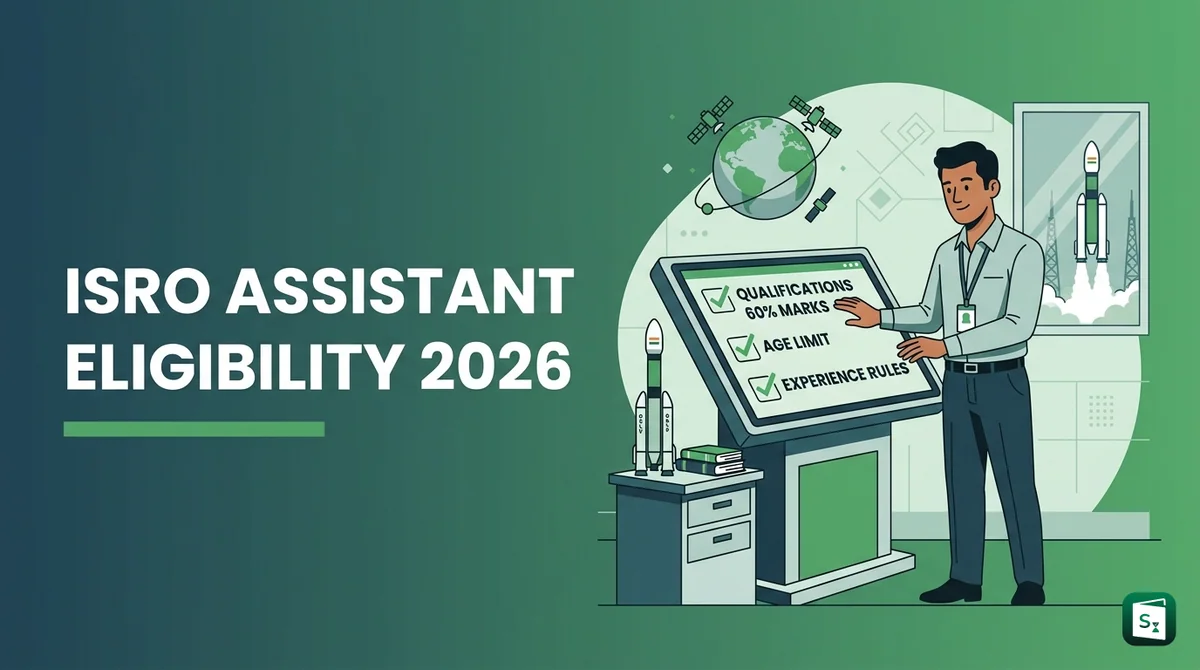
The ISRO Recruitment 2026 notification has opened 267 vacancies for Assistant, Junior Personal Assistant (JPA), Upper Division Clerk (UDC), and Stenographer posts. While the notification covers everything from exam pattern to salary, the eligibility criteria is where most confusion lies. Many candidates lose their chance because they overlook a small detail in the marks requirement, CGPA conversion rules, or computer proficiency condition.
ISRO eligibility has some unique rules that differ from other government exams. The 60% marks requirement is strict, CGPA conversion to percentage is not allowed, and work experience is needed only for certain posts. This article breaks down every eligibility condition for ISRO Assistant UDC eligibility 2026, including the edge cases that the official notification addresses in fine print.
ISRO Assistant UDC Eligibility 2026: Quick Overview
Before diving into the details, here is a snapshot of the eligibility criteria for all posts under ISRO Recruitment 2026:
| Criteria | Assistant / UDC (Post 1, 3, 5) | JPA / Stenographer (Post 2, 4, 6) |
|---|---|---|
| Minimum Qualification | Graduation (60% or CGPA 6.32) | Graduation (60% or CGPA 6.32) OR Diploma in Commercial/Secretarial Practice + 1 year experience |
| Additional Requirement | Computer proficiency | 60 wpm English Stenography + Computer proficiency |
| Age Limit | 28 years (as on 16-08-2026) | 28 years (as on 16-08-2026) |
| Nationality | Indian citizens only | Indian citizens only |
The table above shows two distinct eligibility tracks. Assistant and UDC posts require only graduation with computer proficiency. JPA and Stenographer posts add stenography speed and optional experience requirements on top of the same educational baseline.
Educational Qualification: 60% Marks Requirement
The most discussed eligibility rule in ISRO Recruitment 2026 is the 60% minimum marks in graduation. This applies to every post, whether you are applying for Assistant, UDC, JPA, or Stenographer. The exact wording from the official notification states that candidates must have “graduation with a minimum of 60% marks or CGPA of 6.32 on a 10-point scale as declared by any recognised university.”
Here is what this means in practice:
- 60% marks is mandatory. A candidate with 59.9% is not eligible. ISRO does not round off marks.
- CGPA 6.32 is the equivalent. If your university uses CGPA on a 10-point scale, you need a minimum of 6.32. A CGPA of 6.319 does not qualify.
- Graduation must be from a recognised university. The university must be recognised by the University Grants Commission (UGC) or an equivalent authority.
- Stipulated duration matters. Your graduation must have been completed within the normal duration prescribed by the university. If a 3-year degree took you 5 years due to backlogs, ISRO may consider you ineligible.
Is 60% Marks Mandatory for All Posts?
Yes. Whether you apply for Assistant (Post No. 1), UDC (Post No. 3), JPA (Post No. 2), or Stenographer (Post No. 4), the 60% marks or 6.32 CGPA requirement is the same. There is no relaxation in the minimum percentage for any category, including SC, ST, OBC, or PwBD candidates. Age relaxation applies to the upper age limit, but the marks threshold remains fixed at 60%.
What if Your University Shows Only CGPA?
Many Indian universities now issue degree certificates with only CGPA and no percentage. ISRO has a clear rule for this situation:
- If your degree certificate or consolidated mark-sheet mentions only CGPA, then that CGPA must directly meet the 6.32 threshold.
- Conversion of CGPA into percentage is NOT permitted to determine eligibility, regardless of whether your university prescribes a conversion formula.
- This means you cannot multiply your CGPA by 9.5 (the standard UGC formula) and claim you have 60%. The CGPA itself must be 6.32 or above.
What if Both CGPA and Percentage Are Mentioned?
Some universities mention both CGPA and percentage on the degree certificate or consolidated mark-sheet. In such cases:
- At least one criterion (either CGPA or percentage) must meet ISRO’s eligibility norms.
- If your CGPA is 6.5 but your percentage equivalent shows 58%, you are still eligible because your CGPA meets the 6.32 requirement.
- The same rule applies in reverse: if your percentage is 62% but your CGPA shows 6.2, you are eligible because your percentage meets the 60% threshold.
CGPA to Percentage Conversion: What ISRO Says
This is one of the most misunderstood areas. Many candidates assume they can convert their CGPA to percentage using the standard formula and apply. ISRO explicitly prohibits this.
The official notification states:
“Conversion of CGPA into percentage of marks is NOT permitted to determine eligibility, regardless of whether any conversion formula is prescribed by the University/Institution concerned.”
This means:
- If your certificate shows CGPA 6.5 and nothing else, you are eligible (because 6.5 exceeds 6.32).
- If your certificate shows CGPA 6.0 and you want to convert it to 57% using the formula, you cannot. You are not eligible.
- If your university provides an official conversion certificate, ISRO still does not accept it for eligibility purposes.
The same rule applies in reverse. If your certificate shows only percentage and not CGPA, you cannot convert percentage to CGPA to meet the CGPA threshold.
Dual and Integrated Degree Programs
ISRO has specific rules for candidates with dual or integrated degrees:
- If the Dual/Integrated Degree Certificate mentions CGPA or percentage separately for graduation and post-graduation, then the graduation-level CGPA or percentage will be used to determine eligibility.
- If a common CGPA or percentage is mentioned for the entire course of study, that final CGPA or percentage will be used for eligibility.
- If the university does not mention any CGPA or percentage in the Dual/Integrated Degree certificate, the cumulative CGPA or percentage as per the final or consolidated mark sheet for the entire course will be considered.
Age Limit and Relaxation
The upper age limit for ISRO Recruitment 2026 is 28 years as on 16 August 2026. This applies to all posts, including Assistant, UDC, JPA, and Stenographer. There is no minimum age requirement mentioned in the notification, but candidates must be at least 18 years old as a general rule for government employment.
Category-wise Age Relaxation
| Category | Upper Age Limit | Eligible if Born On or After |
|---|---|---|
| UR / EWS | 28 years | 17-08-1998 |
| OBC (for reserved posts) | 31 years | 17-08-1995 |
| SC / ST (for reserved posts) | 33 years | 17-08-1993 |
Additional Age Relaxation
Beyond the category-based relaxation, the upper age limit is further relaxed for the following categories as per Government of India orders:
- Serving Government employees are eligible for relaxation as per applicable rules.
- Ex-Servicemen get relaxation as per Government of India norms.
- Persons with Disabilities (PwBD) receive age relaxation as per the Rights of Persons with Disabilities Act, 2016.
- Meritorious Sportspersons are eligible for relaxation as per government orders.
- Widows, divorced women, and women judicially separated from their husbands (who have not remarried) also get relaxation as per applicable rules.
How to Calculate Your Age
Use 16 August 2026 as the cut-off date. If you were born on 17 August 1998 or later, you meet the age requirement for the General category. For reserved categories, calculate backward from the relaxed upper limit.
Computer Proficiency Requirement
Computer proficiency is a mandatory eligibility condition for every post under ISRO Recruitment 2026. This applies to Assistant, UDC, JPA, and Stenographer roles alike. The official notification states that candidates must have “proficiency in the use of computers.”
What Does Computer Proficiency Mean for ISRO?
The notification does not specify a particular certificate or qualification for computer proficiency. This means:
- There is no mandatory requirement for a specific computer course certificate (like CCC, O Level, or any other certification).
- However, candidates must be genuinely proficient in basic computer operations, including word processing, spreadsheets, and internet usage.
- The Skill Test stage will assess your actual computer skills. For Assistant and UDC posts, there is a Computer Literacy Test after the written examination.
Is a Computer Course Certificate Required?
ISRO does not explicitly require any computer course certificate in the notification. That said, having a certificate from a recognised institution can strengthen your claim during document verification if your computer skills are questioned. Common certificates that candidates typically hold include:
- Course on Computer Concepts (CCC) from NIELIT
- O Level or higher certifications from NIELIT
- Any diploma or certificate in computer applications from a recognised institution
While none of these are mandatory, they serve as proof of your computer proficiency if asked.
Skill Test for Computer Proficiency
For Assistant and UDC posts, the selection process includes a Computer Literacy Test after the written examination. This is a qualifying test, meaning you need to pass it but your marks in this test do not count toward the final merit. The written test marks alone determine your ranking.
For JPA and Stenographer posts, the Skill Test includes both computer proficiency and stenography assessment.
Experience Rules: Which Posts Need It?
One of the most common questions about ISRO eligibility is whether work experience is required. The answer depends on the post you are applying for.
Posts That Do NOT Require Experience
- Assistant (Post No. 1, 5): No work experience required. Fresh graduates with 60% marks and computer proficiency can apply.
- Upper Division Clerk (Post No. 3): No work experience required. Same eligibility as Assistant.
Posts That Require Experience
- Junior Personal Assistant (Post No. 2, 6): Candidates applying through the Graduation Route do not need experience. However, candidates applying through the Diploma Route (Diploma in Commercial/Secretarial Practice) need one year of experience as Steno-Typist or Stenographer.
- Stenographer (Post No. 4): Same as JPA. Graduation Route candidates do not need experience. Diploma Route candidates need one year of stenography experience.
BOAT Apprenticeship Certificate as Experience
For candidates holding a Diploma in Commercial Practice (DCP) or Diploma in Commercial and Computer Practice (DCCP), ISRO accepts the Apprenticeship Training Certificate issued by the Board of Apprenticeship Training (BOAT) under the National Apprenticeship Training Scheme as equivalent to one year of experience as Steno-Typist or Stenographer. This is an important provision for diploma holders who may not have formal work experience but have completed their apprenticeship.
Summary of Experience Requirements
| Post | Graduation Route | Diploma Route |
|---|---|---|
| Assistant | No experience needed | Not applicable |
| UDC | No experience needed | Not applicable |
| JPA | No experience needed | 1 year as Steno-Typist/Stenographer |
| Stenographer | No experience needed | 1 year as Steno-Typist/Stenographer |
JPA and Stenographer: Stenography Requirements
The JPA and Stenographer posts have an additional skill requirement that Assistant and UDC posts do not have. Candidates must demonstrate a minimum speed of 60 words per minute (wpm) in English Stenography.
What is English Stenography?
Stenography is the practice of writing in shorthand, a rapid writing system using symbols and abbreviations. English Stenography specifically refers to shorthand writing in the English language. The 60 wpm speed means you must be able to take dictation at this rate and later transcribe it accurately.
Which Shorthand Method is Accepted?
The official notification does not specify a particular shorthand method (such as Pitman, Gregg, or any other system). This means:
- Candidates using any standard English shorthand system are eligible.
- The Skill Test will evaluate your actual stenography speed and accuracy, not the method you use.
- What matters is that you can write at 60 wpm and transcribe correctly.
Stenography Skill Test Details
The stenography Skill Test for JPA and Stenographer posts typically involves:
- Dictation passage at 60 wpm in English shorthand.
- Transcription of the dictated passage into English on a computer.
- The test is qualifying in nature. Your written test marks determine your final ranking, not the Skill Test marks.
How to Prepare for Stenography
If you are targeting JPA or Stenographer posts, start practicing shorthand early. Building stenography speed from zero to 60 wpm takes consistent daily practice over several months. Here is a rough timeline:
- Beginners: Allow 4 to 6 months to reach 60 wpm with daily practice of 1 to 2 hours.
- Those with some shorthand background: Allow 2 to 3 months of focused practice to reach the required speed.
Do not wait until after the written examination to begin stenography practice. Start alongside your written exam preparation so both skills develop together.
Diploma Holders: An Alternate Route
Candidates with a Diploma in Commercial Practice (DCP) or Diploma in Commercial and Computer Practice (DCCP) have an alternate pathway to apply for JPA and Stenographer posts. This route is specifically designed for diploma holders who may not have a graduation degree.
Eligibility Through the Diploma Route
To qualify through the Diploma Route, you must meet all of the following conditions:
- Diploma qualification: Diploma in Commercial/Secretarial Practice with minimum 60% marks or CGPA of 6.32 on a 10-point scale from a recognised Board or University.
- Completed within stipulated duration: The diploma must have been completed within the normal course duration prescribed by the issuing institution.
- One year experience: You need one year of experience as a Steno-Typist or Stenographer. Alternatively, a BOAT Apprenticeship Certificate (for DCP/DCCP holders) is accepted as equivalent to this experience.
- Stenography speed: Minimum 60 wpm in English Stenography.
- Computer proficiency: Mandatory for all posts.
Important Points for Diploma Holders
- The Diploma Route is only available for JPA and Stenographer posts. You cannot apply for Assistant or UDC posts with a diploma alone. Assistant and UDC require a graduation degree.
- The 60% marks requirement applies to the diploma as well. There is no relaxation in the marks threshold.
- If you also hold a graduation degree, you can apply through either route, whichever is more convenient for you.
Distance Education and Open University Graduates
A frequent question from aspirants is whether graduation completed through distance education or open universities qualifies for ISRO eligibility. The official notification requires a “graduation degree from a recognised university, completed within the stipulated duration.”
Key Points for Distance/Open University Candidates
- The degree must be from a university recognised by the University Grants Commission (UGC). Most open universities like IGNOU, BRAOU, KSOU, and state open universities are UGC-recognised.
- The degree must be completed within the stipulated duration. For example, if IGNOU prescribes a maximum of 6 years for a 3-year degree programme, you must complete it within that timeframe.
- ISRO does not specifically mention distance education or open university as a separate category. The same eligibility norms apply to all modes of education, whether regular, distance, or online.
- Your degree certificate and mark-sheet must clearly show the CGPA or percentage. The same rules on CGPA conversion apply.
What Candidates Should Do
If you completed your graduation through distance education, ensure that:
- Your university is recognised by UGC at the time of your admission and graduation.
- You have the original degree certificate and consolidated mark-sheet showing your marks or CGPA.
- Your course was completed within the maximum duration prescribed by the university.
If all three conditions are met, you are eligible to apply.
Pay Scale and Career Growth
All posts under ISRO Recruitment 2026 carry a Level 4 Pay Matrix position with a starting basic pay of ₹25,500 per month. In addition to the basic pay, selected candidates receive Dearness Allowance (DA), House Rent Allowance (HRA), Transport Allowance, and other Central Government benefits.
Monthly Salary Estimate
The estimated gross monthly salary for Level 4 posts at ISRO is approximately ₹40,000 to ₹45,000, depending on the posting location and applicable allowances. The exact figure varies because HRA depends on the city classification (X, Y, or Z category) where you are posted.
Career Growth Path
| Post | Starting Level | Promotion Path |
|---|---|---|
| Assistant | Level 4 (₹25,500) | Can progress up to Senior Assistant in Level 6 |
| UDC | Level 4 (₹25,500) | Can progress up to Assistant in Level 7 |
| JPA | Level 4 (₹25,500) | Can progress up to Senior JPA in higher levels |
| Stenographer | Level 4 (₹25,500) | Can progress up to higher levels based on performance |
Promotions are subject to availability of vacancies and satisfactory performance. ISRO follows a merit-based promotion scheme that allows administrative staff to grow into supervisory roles over time.
Selection Process Overview
The selection process for ISRO Recruitment 2026 differs slightly depending on the post you apply for.
For Assistant and UDC Posts
- Written Examination: Objective type test covering General English, General Knowledge, Arithmetic, and Reasoning Ability.
- Computer Literacy Test: Qualifying in nature. Your written test marks determine your final ranking.
- Document Verification: Original documents are verified at this stage.
For JPA and Stenographer Posts
- Written Examination: Similar objective type test as Assistant/UDC posts.
- Skill Test: Includes both English Stenography at 60 wpm and Computer Literacy Test. Qualifying in nature.
- Document Verification: Original documents are verified.
Important: The Skill Test for all posts is qualifying only. Selection is based solely on written examination marks. This means your performance in the written test determines whether you get selected, while the Skill Test just confirms you have the required practical skills.
Official and Helpful Links
What to do next?
If you meet the ISRO Assistant UDC eligibility 2026 criteria, do not waste time. The last date to apply is 20 August 2026. Visit the official ISRO website at www.isro.gov.in and complete your online application before the deadline. Read the full official notification carefully to understand every condition before submitting your form. Start preparing for the written examination immediately, and if you are targeting JPA or Stenographer posts, begin stenography practice from today itself. For current affairs and English language preparation that will help you in the written exam, explore the Scoreclever blog for daily updates and preparation strategies.